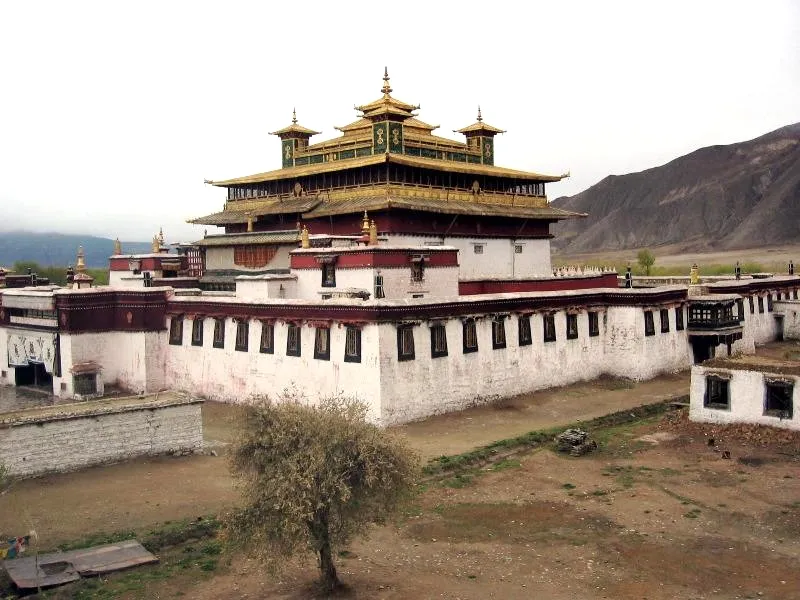
Tibet's first Buddhist monastery, founded in the 8th century as a mandala-shaped complex representing the Buddhist cosmos. Here Padmasambhava tamed the spirits of Tibet, and the first Tibetan monks took ordination.
The Dawn of Buddhism in Tibet
Samye stands as the monument to a revolution. Before its founding in the 8th century, Tibet was a land of mountain spirits and warrior kings, where the indigenous Bön religion held sway and Buddha’s teachings were largely unknown. Within a generation, this monastery would transform Tibetan civilization forever.
The story of Samye is inseparable from the three figures known as the Khen-Lop-Chö Sum — the Abbot (Khen), the Master (Lop), and the Dharma King (Chö): Shantarakshita, Padmasambhava, and King Trisong Detsen. Together, they accomplished what none could have done alone.
The Three Founders
King Trisong Detsen (742-797)
The second of Tibet’s three great Dharma Kings, Trisong Detsen inherited a powerful empire but recognized that military conquest alone could not bring lasting benefit to his people. Inspired by Buddhism, he invited the renowned Indian scholar Shantarakshita to Tibet to establish the dharma.
But the spirits of Tibet had other plans. As Shantarakshita began teaching and the construction of a monastery was attempted, disasters struck repeatedly. Floods destroyed foundations. Lightning struck buildings. Epidemics broke out. The local spirits, protecting their domain, made clear their opposition to this foreign religion.
Shantarakshita (725-788)
The great Indian abbot recognized what was happening. “I am a scholar and a monk,” he told the king. “I can teach the dharma, but I cannot subdue the spirits of this wild land. For that, you need a master of another kind — the great tantric adept Padmasambhava, who dwells in the charnel grounds of India.”
Shantarakshita’s humility and wisdom in recognizing his own limitations made Samye possible. He returned to Nepal to wait, while messengers were sent to find the legendary Guru from Oddiyana.
Padmasambhava
When the master known as Guru Rinpoche arrived, everything changed. As he entered Tibet, each spirit, demon, and local deity that rose against him was conquered — not destroyed, but transformed. The nagas who caused floods became protectors of the dharma. The mountain spirits who hurled lightning became guardians of monasteries. One by one, Padmasambhava bound them all with oaths to protect Buddhism and those who practice it.
By the time he reached the site of Samye, the way was clear. The spirits who had once fought the monastery’s construction now helped build it.
The Mandala Temple
Samye’s design is its teaching. The monastery is built as a three-dimensional mandala — a symbolic representation of the Buddhist cosmos:
The Central Temple (Utse) represents Mount Meru, the axis of the universe. Its three stories reflect the three main Buddhist architectural styles, symbolizing the unity of all Buddhist traditions:
- The ground floor is Tibetan style
- The middle floor is Chinese style
- The upper floor is Indian style
Originally, this central temple rose five stories, though it has been reduced through various reconstructions. The main assembly hall houses a famous statue of Shakyamuni Buddha flanked by his two main disciples, along with images of Padmasambhava and the monastery’s founders.
The Four Great Temples at the cardinal directions represent the four continents surrounding Mount Meru in Buddhist cosmology:
- East: Jambu Ling (our world)
- South: Dzambu Ling
- West: Balang Chö
- North: Dra Mi Nyen
Eight Smaller Temples represent the eight sub-continents.
The Sun and Moon Temples represent the celestial bodies.
The Circular Outer Wall originally had 1,008 small stupas, representing the protective ring of iron mountains that surrounds the universe.
Walking through Samye is thus walking through the Buddhist cosmos itself, with the pilgrim at the center, approaching Mount Meru — the symbol of enlightenment.
The First Seven Monks
In 779 CE, after the monastery’s completion, Shantarakshita ordained the first seven Tibetan monks — the Sad Mi Bdun (Seven Men for Testing). These were noble youths chosen to test whether Tibetans could maintain monastic discipline. Their successful ordination proved that the dharma could take root in Tibetan soil.
From these seven, the monastic lineage of Tibet grew to eventually number hundreds of thousands of monks and nuns, making Tibet proportionally the most monastic society in human history.
The Translation Temple
At the eastern part of the complex stood the Translation Hall, where one of the most remarkable intellectual enterprises in history took place. Here, teams of Indian masters and Tibetan translators worked for decades to render the entire Buddhist canon into Tibetan.
The translators — figures like Vairochana, Kawa Paltsek, and Chokro Lui Gyaltsen — didn’t merely translate words. They essentially created literary Tibetan, developing new terms and grammatical structures to express concepts that had never before been articulated in their language.
Under the guidance of Padmasambhava, Shantarakshita, and later masters like Vimalamitra, they produced translations of extraordinary precision and beauty. Many Indian Buddhist texts survive today only in these Tibetan translations, the Sanskrit originals having been lost.
The Great Debate
Samye was also the site of the famous Council of Lhasa (792-794), a formal debate between representatives of Indian “gradual” Buddhism and Chinese “sudden” Ch’an (Zen) Buddhism. The Indian position, arguing for gradual cultivation of merit and wisdom, was championed by Kamalashila, a student of Shantarakshita. The Chinese position was represented by the Ch’an master Moheyan (Hvashang Mahayana).
According to Tibetan sources, the Indian gradualist position won, establishing the dominance of Indian Buddhist philosophy in Tibet. This decision shaped the entire subsequent development of Tibetan Buddhism, with its emphasis on systematic study and progressive stages of the path.
Scholars debate the historical details, but the debate’s significance is clear: it was here, at Samye, that Tibet consciously chose its Buddhist direction.
The Terma Tradition Begins
Before leaving Tibet, Padmasambhava is said to have hidden countless spiritual treasures (terma) throughout the land — teachings destined to be revealed by future masters when the time was right. Samye and its surroundings are especially rich in such treasures.
Many of the great tertöns (treasure revealers) of Tibetan history have discovered texts, objects, and practices hidden by Guru Rinpoche in and around Samye. This tradition continues today, maintaining Samye’s status as a living source of Buddhist revelation.
Destruction and Restoration
Like all Tibetan monasteries, Samye suffered terribly during the Cultural Revolution. Much of the complex was destroyed, and its monks were dispersed or killed. Ancient murals were defaced, statues smashed, and libraries burned.
Yet Samye proved impossible to kill entirely. Restoration began in the 1980s and continues today. Though much has been lost — including virtually all of the original 8th-century structures — the monastery has been substantially rebuilt and remains an active place of worship and pilgrimage.
The restoration itself is a teaching in impermanence. The buildings Padmasambhava blessed are gone, yet his blessing continues to manifest through the devotion of those who rebuild, pray, and practice at this sacred site.
Pilgrimage at Samye
Modern pilgrims to Samye typically include:
The Utse — The central temple, with its remarkable combination of architectural styles and precious images. The inner circumambulation corridor contains murals depicting the history of Buddhism in Tibet.
The Guru Rinpoche Chapel — On the upper floor, containing images and relics associated with Padmasambhava. The air is thick with the smoke of butter lamps and incense.
The Yamantaka Temple — Houses fierce protective deities and is associated with advanced tantric practice.
Chimpu Hermitage — About 8 kilometers northeast, a hillside riddled with over 100 caves where Padmasambhava, Yeshe Tsogyal, Vairochana, and countless other masters meditated. Many pilgrims consider the trip to Samye incomplete without a visit to these caves.
Hepo Ri — The sacred hill above the monastery where Padmasambhava is said to have meditated and subjugated the spirits of Tibet. A kora path leads to the summit.
The Living Tradition
Today, Samye belongs to the Nyingma tradition, though all Tibetan Buddhists revere it. Monks once again perform rituals in the temple halls, and pilgrims arrive daily to receive blessings at the site where their religion was born.
During the annual Samye Dochey Festival, the monastery comes alive with sacred masked dances (cham), recreating Padmasambhava’s subjugation of demons and the establishment of dharma in Tibet. These dances are both entertainment and empowerment — those who witness them with faith are said to receive the blessings of Guru Rinpoche himself.
For Tibetan Buddhists, visiting Samye is visiting the source. Here, in this mandala built on the Tibetan plateau, a civilization was transformed. The spirits that once opposed the dharma became its protectors. The warriors who once built empires through conquest learned to build enlightenment through practice. And a tradition was established that would preserve Buddhism for a thousand years, carrying it safely through the centuries until it could spread to a waiting world.
Associated Masters
Principal Deities
Sacred Festivals
Samye Dochey Festival
5th month of Tibetan calendarSacred mask dances commemorating Padmasambhava's subjugation of demons
Recommended Practices
- ༔ Circumambulation of the main temple (utse) and the entire complex
- ༔ Prayer and prostration before the Guru Rinpoche statue
- ༔ Pilgrimage to Chimpu caves (8km away)
- ༔ Meditation in the upper-floor chapels
- ༔ Recitation of the Seven Line Prayer