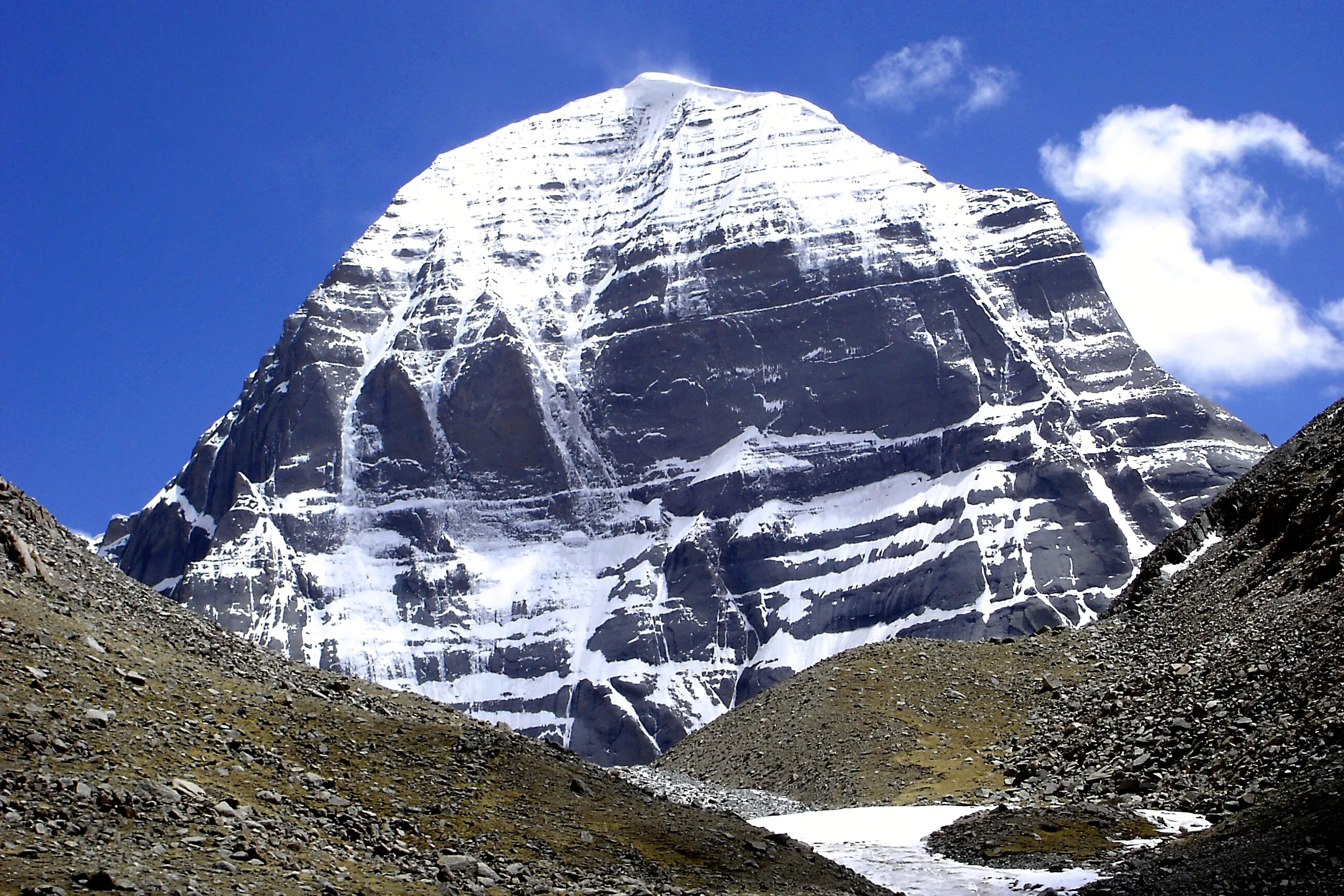
The most sacred mountain in Vajrayana Buddhism, considered the earthly manifestation of Mount Meru and the abode of Chakrasamvara. For millennia, pilgrims have circumambulated its base, believing a single kora can erase the sins of a lifetime.
The Jewel of the Snows
Mount Kailash rises from the high Tibetan plateau like nothing else on earth. Its four faces, aligned almost perfectly with the cardinal directions, have never been climbed — not because it cannot be, but because it is too sacred. The Chinese government has permanently banned climbing attempts, honoring the beliefs of the billion-plus devotees across four religions who consider this mountain the center of the universe.
For Tibetan Buddhists, Kailash is Kang Rinpoche — the Precious Snow Mountain. It is the earthly palace of Chakrasamvara (Demchok), the principal meditational deity of the highest yoga tantra, who dwells there in eternal union with his consort Vajrayogini. The mountain itself is understood to be a natural three-dimensional mandala, its very form an expression of enlightened reality.
Sacred Geography
The region around Kailash forms what Tibetans call the great maṇḍala of body, speech, and mind:
Mount Kailash represents the body — the physical manifestation of enlightened presence. Its distinctive shape, a near-perfect pyramid of ice and rock, rises in stark solitude from the surrounding landscape. The dark bands of rock running horizontally across its southern face form what appears to be a natural swastika — an ancient symbol of eternity and well-being that predates its 20th-century corruption.
Lake Manasarovar (Mapham Yumtso), lying 30 kilometers to the south, represents mind — the clarity and purity of awakened awareness. Its waters are considered supremely pure, and pilgrims bathe in them despite the cold, believing this purifies countless lifetimes of negative karma.
The Sutlej, Brahmaputra, Karnali, and Indus rivers all have their sources near Kailash, flowing to the four directions like the flow of dharma to all beings. This geographic reality reinforced the ancient cosmological belief that Kailash is Mount Meru, the axis of the universe from which the four great rivers flow.
The Kora: Circumambulation of the Sacred
The kora around Mount Kailash covers approximately 52 kilometers (32 miles) and typically takes three days for walking pilgrims. Devout Buddhists believe that:
- One kora purifies the negative karma of this lifetime
- Thirteen koras prevent rebirth in the lower realms
- 108 koras guarantee enlightenment in this very life
The path begins and ends at Darchen (4,575m), a small town that serves as the base for pilgrimage. From here, the route moves clockwise (unlike Bön practitioners, who circumambulate counter-clockwise) through some of the most spiritually charged landscape on earth.
Day One: Darchen to Dirapuk (18km)
The first day’s walk takes pilgrims along the western face of Kailash to Dirapuk Monastery (5,080m), whose name means “cave of the female yak horn.” According to tradition, the Buddhist master Götsangpa discovered this site in the 13th century when a yak led him to a cave here. The monastery sits directly facing Kailash’s spectacular north face, the most photographed aspect of the mountain.
The walk passes Tarboche, a flagpole that marks the beginning of the inner kora. During Saga Dawa, the flagpole is replaced in an elaborate ceremony — its angle after erection is read as an omen for the coming year. A pole leaning toward Kailash indicates good fortune; away from it suggests difficulties ahead.
Day Two: Dirapuk to Zutulpuk (22km)
This is the hardest day, crossing the Dolma La pass at 5,630 meters — the highest point of the kora and one of the most sacred. The pass is named for Tara (Dölma), the female bodhisattva of compassion, whose boulder sits at the summit draped in prayer flags.
Just before the pass, pilgrims pass Shiva Tsal, the “charnel ground” where pilgrims traditionally leave an item of clothing or a drop of blood to symbolize their death and rebirth. Leaving something of the old self behind, they climb to the pass and descend into a new life.
Beyond the pass lies Gauri Kund, a small lake of emerald green considered sacred to Parvati. Despite the extreme altitude and cold, some pilgrims break through ice to bathe in its waters.
The day ends at Zutulpuk Monastery, named for a cave where Milarepa is said to have meditated and engaged in a famous contest of magical powers with the Bön master Naro Bonchung.
Day Three: Zutulpuk to Darchen (12km)
The final day is an easy walk back to Darchen along the southern face. Pilgrims often stop at the Selung Monastery ruins and various sacred spots along the way, completing their circuit at the starting point with prayers of dedication.
Milarepa and Naro Bonchung: The Contest
One of the most beloved stories associated with Kailash is the competition between the great Buddhist yogi Milarepa (1040-1123) and the Bön priest Naro Bonchung for spiritual supremacy at the mountain.
The two masters agreed to race to the summit of Kailash. Naro Bonchung set off immediately, flying through the air on his ritual drum. Milarepa, seemingly unconcerned, sat meditating in his cave. His disciples grew anxious as dawn approached — the agreed time for the contest to end.
At the first rays of sunlight, Milarepa suddenly shot upward on a beam of light, instantly reaching the summit just as Naro Bonchung was about to arrive. The Bön master, shocked, fell backward, his drum tumbling down the south face and leaving the vertical grooves still visible today.
The contest established Buddhism’s supremacy at Kailash, though Milarepa, showing compassion, offered Naro Bonchung the nearby Lake Rakshas Tal as a Bön sacred site. The story also explains why Buddhists circumambulate clockwise (following the sun, as Milarepa did) while Bön practitioners go counter-clockwise.
The Four Faces
Each of the four faces of Kailash holds particular significance:
The South Face is the one most pilgrims see from Darchen. The dark horizontal striations and central vertical channel form what appears to be a swastika (a sacred symbol in Buddhism and Hinduism) and below it a natural dome shape. This face is associated with Amitabha, the Buddha of Infinite Light.
The West Face is viewed during the first day of kora. It is associated with Amoghasiddhi, the Buddha of Unerring Accomplishment.
The North Face, seen from Dirapuk, is the most dramatic — a sheer wall of ice and rock rising 2,000 meters. It is associated with Akshobhya, the Immovable Buddha. The horizontal bands of rock are said to be the steps of a stairway to heaven.
The East Face is the least seen by pilgrims, as the kora route doesn’t offer clear views. It is associated with Ratnasambhava, the Buddha of Equanimity and Abundance.
Preparing for the Pilgrimage
Kailash is not an easy pilgrimage. The combination of high altitude, remote location, and challenging terrain requires serious preparation:
Physical preparation should begin months in advance. The kora involves walking 50+ kilometers at altitudes between 4,500 and 5,600 meters. Proper acclimatization in Lhasa (3,650m) for at least 3-4 days before proceeding to Kailash is essential.
Permits are required for all foreign visitors and must be arranged through registered tour operators. Individual travel to the region is not permitted. The process involves multiple permits: a Tibet Travel Permit, Alien’s Travel Permit, and Military Permit for the Kailash region.
Timing is crucial. The pilgrimage season runs from late April to early October, with Saga Dawa (the full moon of the fourth Tibetan month, usually in May or June) being the most auspicious time. However, this is also the most crowded.
Spiritual preparation is equally important. Many pilgrims undertake preliminary practices in the months before their journey: accumulating mantras, making offerings, and generating strong motivation to make the pilgrimage meaningful.
The Inner and Secret Koras
Beyond the outer kora that most pilgrims complete, there are two additional, more esoteric circuits:
The Inner Kora (Nangkor) is a shorter path closer to the mountain, circumambulating the Nandi (the hill directly facing Kailash’s south face). This kora is said to require completion of 13 outer koras before it can be undertaken.
The Secret Kora is known only to advanced practitioners and involves circumambulating even closer to the mountain’s base. It is said to be accessible only to those who have completed 13 inner koras and have received specific empowerments.
These restrictions are not arbitrary — they reflect the Vajrayana understanding that sacred power must be approached gradually, with proper preparation and purification.
What Pilgrims Experience
Those who have completed the Kailash kora often describe it as a profoundly transformative experience. The physical challenge, the thin air, the stark beauty, and the accumulated prayers of countless previous pilgrims create conditions unlike anywhere else on earth.
Many report vivid dreams, unusual weather phenomena, or unexpected emotional releases at particular points along the route. Whether understood as blessings from the mountain, the ripening of karma, or simply the effects of altitude and exertion, these experiences are taken as signs that the pilgrimage is doing its work.
At the root of the experience is something simpler: the act of placing one foot in front of another, hour after hour, in devotion to something beyond oneself. In this, the Kailash kora shares something essential with every spiritual path — the transformation that comes from sustained, embodied practice in the service of awakening.
Associated Masters
Principal Deities
Sacred Festivals
Saga Dawa
Full moon of 4th Tibetan month (May/June)The holiest time to circumambulate Kailash, commemorating Buddha's birth, enlightenment, and parinirvana
Kailash Parikrama
April to OctoberThe traditional pilgrimage season when weather permits the full kora
Recommended Practices
- ༔ Kora (circumambulation) — typically 3 days walking, or 2 weeks with full prostrations
- ༔ Prostrations at Tarboche flagpole
- ༔ Bathing in Lake Manasarovar
- ༔ Mantra recitation of Om Mani Padme Hum throughout the journey
- ༔ Offering of prayer flags at Dolma La pass