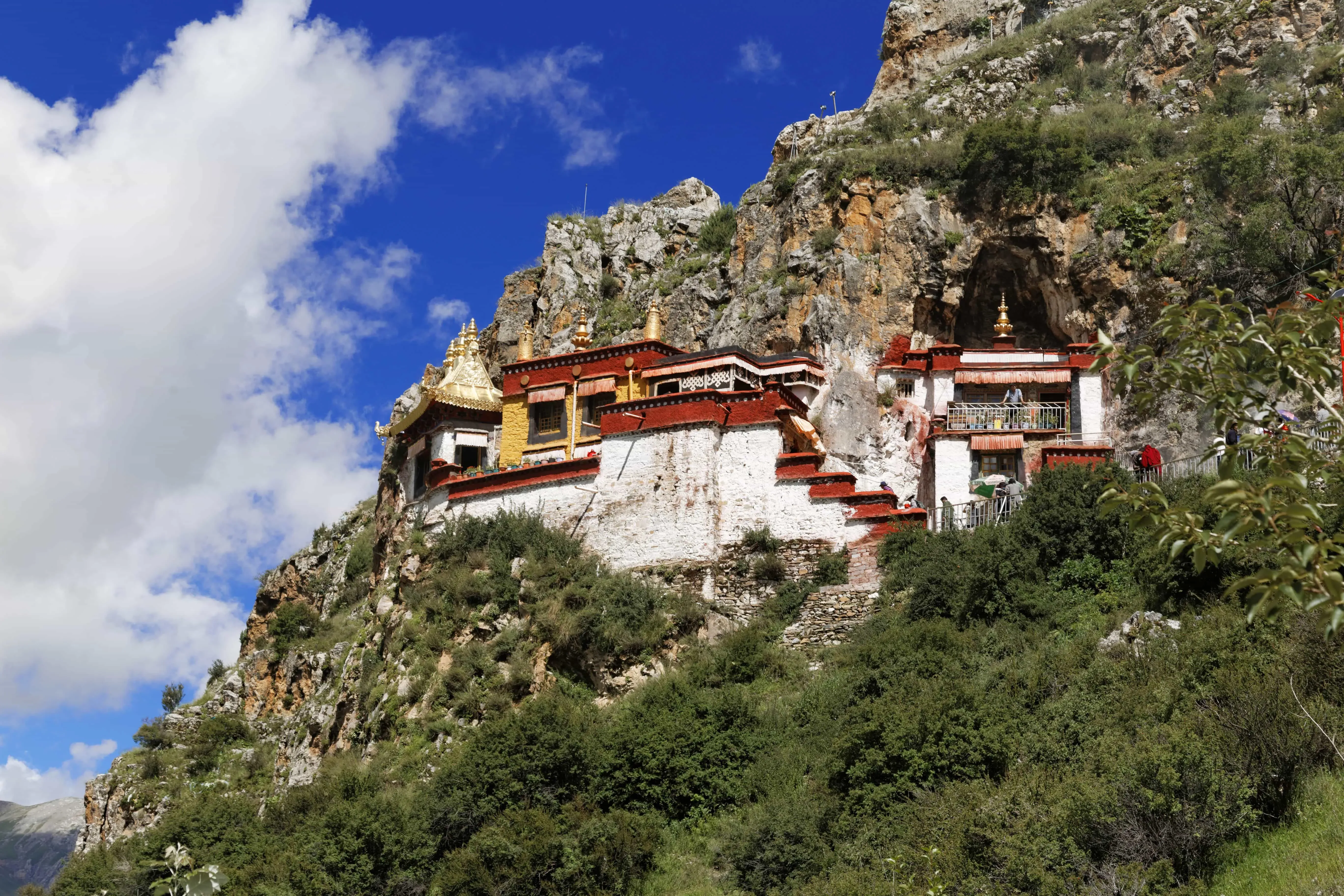
One of Tibet's most sacred cave complexes, where Padmasambhava meditated for seven months achieving wrathful accomplishments. Over 100 meditation caves dot this cliff face, blessed by centuries of intensive practice.
The Cliff of Meditation
Thirty kilometers northeast of Lhasa, a dramatic cliff face rises above the valley floor, its surface pockmarked with over 100 meditation caves. This is Drak Yerpa — one of Tibet’s most ancient and powerful practice sites, where Padmasambhava spent seven months in intensive retreat and countless masters have achieved realization in the centuries since.
The name “Yerpa” may derive from “yar” (summer), as the site was traditionally used for summer retreats when the high altitude made conditions bearable. Or it may come from the experience of the place itself — stepping into these caves feels like entering another dimension, where the boundary between ordinary reality and awakened presence becomes permeable.
Padmasambhava at Drak Yerpa
According to tradition, Padmasambhava meditated at Drak Yerpa for seven months, focusing particularly on wrathful practices. In one cave, he accomplished the practice of Vajrakilaya, the wrathful deity who destroys obstacles. The power of his practice is said to have left impressions in the rock itself.
The Dawa Puk (Moon Cave) is identified as Guru Rinpoche’s primary meditation site. Inside, pilgrims can see what is said to be his meditation seat and hand impressions in the rock. A self-arisen letter “A” — the primordial syllable representing the nature of mind — appeared in the stone during his practice.
Yeshe Tsogyal, Padmasambhava’s primary consort and the first Tibetan woman to achieve enlightenment, also practiced extensively at Drak Yerpa. Her cave, located above Guru Rinpoche’s, is a site of particular devotion for female practitioners.
Other Masters of Drak Yerpa
The blessing of Padmasambhava’s practice drew subsequent generations of masters to Drak Yerpa:
King Songtsen Gampo (7th century): The dharma king who first brought Buddhism to Tibet is said to have meditated here even before Padmasambhava’s time, in a cave dedicated to Avalokiteshvara.
Atisha (11th century): The great Indian master who sparked the second spread of Buddhism in Tibet spent time in retreat at Drak Yerpa. His cave is one of the most visited.
Lhalung Palgyi Dorje: The monk who assassinated the anti-Buddhist king Langdarma is said to have hidden at Drak Yerpa, practicing in secret to purify the karma of his act (which, though violent, is considered to have saved Buddhism in Tibet).
Many Kagyu and Nyingma masters used Drak Yerpa for retreat over the centuries, adding their realization to the accumulated blessing of the site.
The Cave Complex
The caves of Drak Yerpa extend across a limestone cliff at high altitude. The climb from the base to the upper caves is strenuous, especially given the elevation (nearly 4,900 meters). Key sites include:
Chögyal Puk (Dharma King’s Cave): Associated with Songtsen Gampo and his meditation on Avalokiteshvara.
Dawa Puk (Moon Cave): Padmasambhava’s primary practice cave, containing his meditation seat and rock impressions.
Drubpuk Namkha (Space Accomplishment Cave): Where Padmasambhava is said to have achieved space-like realization.
Jampa Lhakhang: A small temple built into the cliff face, housing sacred images.
Atisha’s Cave: Where the great Indian master meditated during his years in Tibet.
Before the Cultural Revolution, Drak Yerpa was home to a thriving monastic community. The monastery was destroyed during that period but has been partially rebuilt. Today, a small number of monks maintain the site and assist pilgrims.
Practice at Drak Yerpa
Drak Yerpa is particularly associated with wrathful practices — Vajrakilaya, Hayagriva, and other fierce deities who cut through obstacles. Practitioners report that the energy of the place supports this kind of intensive, penetrating practice.
For pilgrims, the main practices include:
- Visiting each major cave and making prostrations, offerings, and prayers
- Circumambulating the cliff face on the kora path
- Meditating in the caves (shorter sessions for day visitors; longer retreats require monastic permission)
- Receiving blessing from the self-arisen objects and rock impressions
The climb itself becomes a practice — the physical exertion at altitude, combined with the power of the site, often produces profound experiences for pilgrims.
Pilgrimage to Drak Yerpa
Getting there: Drak Yerpa is about 30 km northeast of Lhasa, accessible by road. Most pilgrims visit as a day trip from Lhasa.
What to bring: Warm clothing (the altitude makes it cold even in summer), water, offerings for the caves, and appropriate permits.
Physical preparation: The climb to the upper caves is demanding at nearly 5,000 meters. Acclimatize in Lhasa first.
Timing: Saga Dawa (4th Tibetan month) draws many pilgrims. For quieter visits, go on ordinary days.
Drak Yerpa remains one of the most powerful practice sites in Central Tibet — a place where the blessing of Padmasambhava’s seven-month retreat continues to support practitioners who come to engage with the dharma in these ancient caves.
Associated Masters
Principal Deities
Sacred Festivals
Saga Dawa
4th Tibetan monthIntensive pilgrimage and practice during Buddha's enlightenment month
Recommended Practices
- ༔ Cave retreat (with permission)
- ༔ Circumambulation of the cliff
- ༔ Prostrations at each major cave
- ༔ Wrathful deity practices