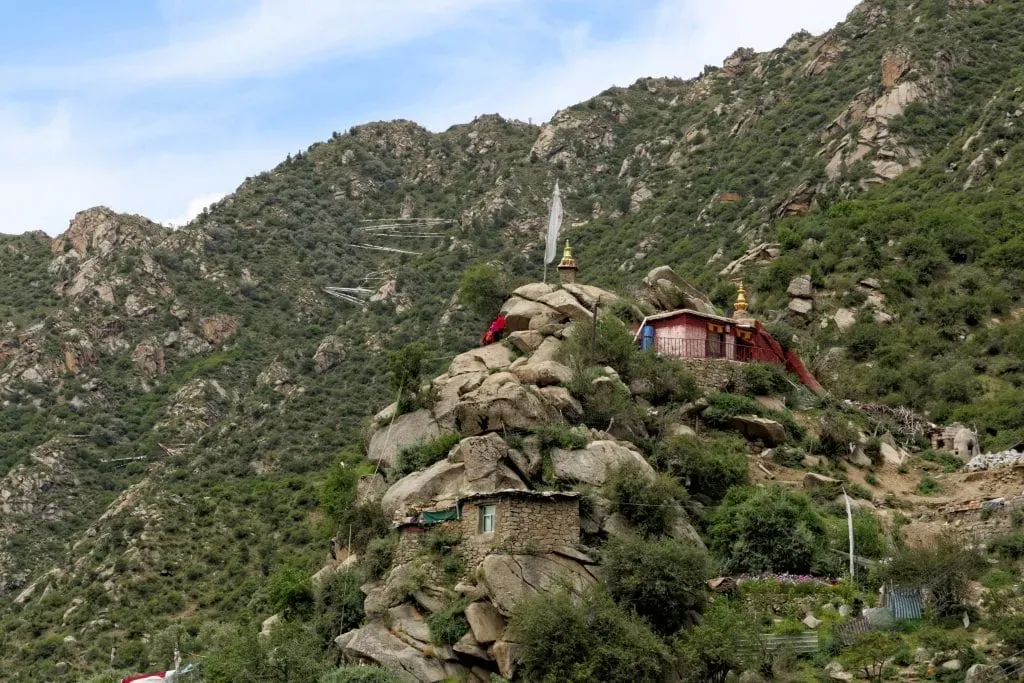
A sacred cave complex near Samye where Padmasambhava, Yeshe Tsogyal, and the great translators meditated. Over 100 caves dot this hillside, each carrying the blessings of masters who achieved realization here.
The Meditation Caves of the Masters
Eight kilometers from Samye Monastery, the hillside of Chimpu rises steeply, pockmarked with over 100 caves. This is one of the most sacred retreat sites in Tibet — the place where Padmasambhava and his closest disciples practiced intensively, achieving the highest realizations and hiding terma treasures for future generations.
For practitioners of Vajrayana Buddhism, Chimpu is not merely historical. The blessings generated by the masters who practiced here are understood to remain, accessible to those who come with faith. To meditate in a cave where Guru Rinpoche sat is to inherit something of his realization.
Padmasambhava’s Cave
The most sacred site at Chimpu is the Drakmar Keutsang — Guru Rinpoche’s own meditation cave. Here, according to tradition, Padmasambhava practiced the wrathful deity Vajrakilaya and achieved supreme accomplishment.
The cave contains:
- An image of Padmasambhava
- His meditation seat
- Imprints said to be made by his body
- A stone marked with what devotees see as his footprint
Adjacent is the cave of Yeshe Tsogyal, his primary consort and the first Tibetan woman to achieve enlightenment. She practiced here alongside her master and later returned alone for extended retreats.
The Translators’ Caves
Chimpu was also the retreat site for the great translators who rendered Buddhist texts into Tibetan:
Vairochana, the greatest of Tibetan translators, practiced in a cave here. He was one of the first seven Tibetan monks and later brought the Dzogchen teachings from India.
Vimalamitra, the Indian master, also meditated at Chimpu. He transmitted essential Dzogchen teachings that form the heart of the Nyingma tradition.
These translators didn’t merely convert words between languages — they transmitted the dharma itself, ensuring that the full depth of Buddhist realization would be available to Tibetans for centuries to come.
Practicing at Chimpu
Today, Chimpu remains an active retreat site. Small meditation huts and caves house practitioners undertaking retreats of various lengths. The atmosphere is one of profound stillness and devotion.
Day pilgrims can:
- Visit Guru Rinpoche’s cave and receive blessing
- Circumambulate the various sacred sites
- Make offerings at the small shrines
- Meditate in open caves
Longer retreats require permission and typically connection with a monastery. For serious practitioners, spending time at Chimpu — in the very caves where the masters practiced — is considered extraordinarily beneficial for one’s spiritual development.
The climb to the upper caves is steep and challenging, especially at high altitude. But those who make the effort find themselves in one of the most powerful practice environments in the Buddhist world, surrounded by the presence of the masters who opened Tibet to the dharma.
Associated Masters
Principal Deities
Recommended Practices
- ༔ Meditation in the various caves
- ༔ Prostrations at Guru Rinpoche's cave
- ༔ Circumambulation of the hermitage area
- ༔ Retreat practice (with permission)