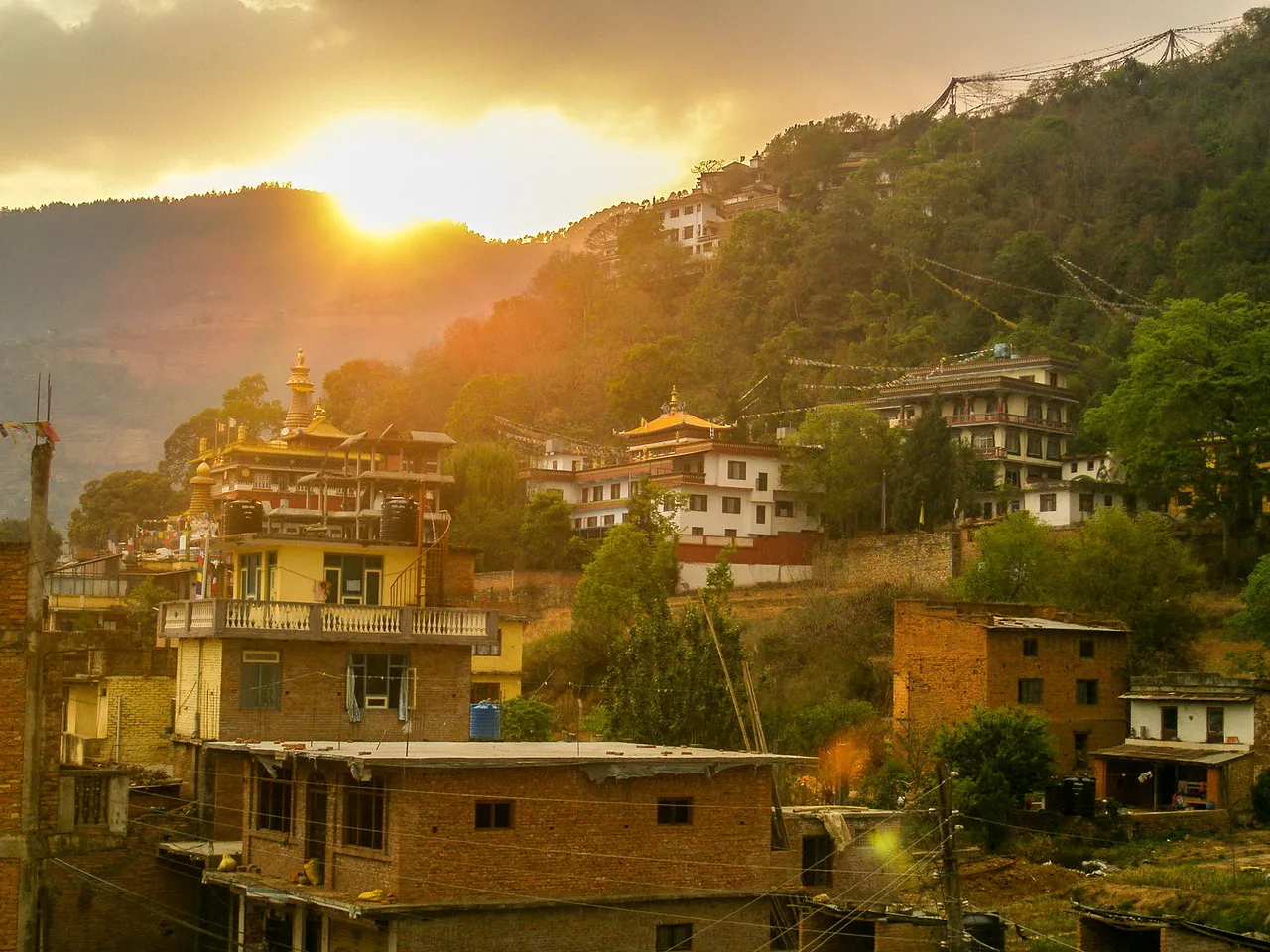
Where Padmasambhava attained the supreme realization of Mahamudra Vidyadhara, the third of four levels of tantric accomplishment. The Asura Cave still bears his handprint impressed into solid rock — a testament to his mastery over the elements.
The Cave of Supreme Realization
In the hills south of Kathmandu, less than an hour’s drive from the tourist crowds of Thamel, lies one of the most powerful Vajrayana sacred sites in existence. Here, in a small cave overlooking the Kathmandu Valley, Padmasambhava accomplished what few beings in any age have achieved: he attained the Mahamudra Vidyadhara level — the third of four stages of supreme tantric realization.
Yanglesho (ཡང་ལེ་ཤོད), now called Pharping in Nepali, is where the legendary master broke through the final obstacles to his enlightenment. The story of how he did so — battling demonic forces with the fierce practice of Vajrakilaya — has inspired tantric practitioners for twelve centuries.
For modern pilgrims, Pharping offers something remarkable: authentic caves where realized masters practiced, still radiating the power of their accomplishment, and still accessible to anyone who makes the journey.
The Story of Padmasambhava at Yanglesho
According to traditional accounts, Padmasambhava came to Yanglesho (also known as the Asura Cave) to practice the meditation of Yangdak Heruka, a wrathful deity practice for attaining enlightenment. He was accompanied by his consort, the Nepali princess Shakyadevi, daughter of the king.
As his practice intensified, obstacles arose. Powerful spirits and local demons, disturbed by his growing realization, created havoc: drought struck the land, epidemics spread, and natural disasters threatened. These were not merely physical phenomena but the external manifestation of inner obstacles to enlightenment — the final barriers that must be overcome before supreme realization.
Padmasambhava sent messengers to India, requesting that his teachers send him a practice powerful enough to overcome these obstacles. They sent the transmission of Vajrakilaya (རྡོ་རྗེ་ཕུར་པ), the wrathful deity who embodies the power to destroy all obstacles on the path.
With this practice, Padmasambhava subdued the obstructing forces. The drought ended, the epidemics ceased, and — most importantly — he broke through the final barriers to realization. In that cave at Yanglesho, he attained the Mahamudra Vidyadhara level, which traditional texts describe as the stage where the practitioner gains mastery over appearances, can transform matter at will, and achieves a level of realization from which buddhahood in this very lifetime is certain.
The proof of his accomplishment remains visible today: his handprint, impressed into solid rock as if into wet clay, marks the spot where he achieved this realization.
The Asura Cave
The Asura Cave (also called Drölma Cave or Guru Rinpoche Cave) is the primary pilgrimage site at Pharping. It is a small natural cave in a hillside, now enclosed within a temple structure maintained by the Nyingma tradition.
What you’ll find:
The handprint: On the rock face inside the cave, Padmasambhava’s handprint is clearly visible, impressed several inches into the solid stone. This is not a carving — the rock appears to have been soft at the moment of contact, then hardened again, preserving the impression for over a thousand years. Pilgrims touch their foreheads to this handprint, receiving blessing.
Self-arisen images: Over the centuries, various forms have been reported appearing in the rock of the cave — images of deities, mantras, and auspicious symbols that seem to emerge gradually from the stone. Whether understood as natural formations interpreted through devoted eyes or as genuinely miraculous appearances, these images add to the cave’s mystique.
Butter lamps: The cave is perpetually lit by butter lamps, their smoke darkening the ceiling and filling the space with the particular atmosphere of Tibetan sacred sites.
The spring: Below the cave, a spring is said to have been blessed by Guru Rinpoche. Its water is considered sacred, and pilgrims drink it and collect it for blessing.
The Yangleshö Cave
A short walk uphill from the Asura Cave is a second cave site, sometimes called the Yangleshö Cave proper. This cave is associated with Padmasambhava’s actual meditation practice, as distinct from the Asura Cave where he made his breakthrough.
The site is smaller and less developed but equally sacred. Pilgrims typically visit both caves as part of a single pilgrimage, circumambulating each and receiving blessings at both locations.
The Vajrayogini Temple
Above the caves, up a steep stairway, sits a temple dedicated to Vajrayogini (Tibetan: Dorje Naljorma), the principal female buddha of highest yoga tantra. This is not a Tibetan temple but a Newar Buddhist site, representing the indigenous Buddhist tradition of the Kathmandu Valley.
The temple houses a famous image of Vajrayogini that is considered self-arisen — not made by human hands but manifested through spiritual power. It is one of the most important Vajrayogini sites in Nepal and draws practitioners of all Tibetan lineages as well as Newar Buddhists.
For tantric practitioners who have received Vajrayogini empowerment, this temple is an essential pilgrimage. The goddess herself is believed to be particularly present here, and practices performed at this site are said to be especially powerful.
Vajrakilaya: The Practice That Overcame All Obstacles
Pharping is inseparably connected to Vajrakilaya (Sanskrit) or Dorje Phurba (Tibetan), the wrathful deity whose practice enabled Padmasambhava’s breakthrough. This deity takes the form of a fierce figure wielding a three-bladed phurba (ritual dagger), representing the power to cut through all obstacles with the three qualities of bliss, clarity, and non-thought.
For practitioners who have received the Vajrakilaya empowerment, Pharping is the supreme site for this practice. The power that Padmasambhava generated here is said to remain, making any Vajrakilaya practice performed in these caves extraordinarily effective.
Even for practitioners without this specific empowerment, simply being present at the site where this great accomplishment occurred is considered highly beneficial. The blessing of Padmasambhava’s realization saturates the location.
The Dakshinkali Road
Pharping sits along the road to Dakshinkali, a famous Hindu temple dedicated to the fierce goddess Kali. The juxtaposition is not accidental — this area south of Kathmandu has long been associated with powerful tantric practices in both Hindu and Buddhist traditions. The valley’s geography, with its hills, caves, and gorges, creates the kind of isolated, wild landscape that tantric practitioners have always favored.
Many pilgrims combine visits to Pharping’s Buddhist caves with a trip to Dakshinkali, experiencing both traditions’ approaches to wrathful divine energy. The similarities are striking: both Buddhist Vajrakilaya and Hindu Kali represent the fierce aspect of awakened energy that destroys obstacles and negative forces.
Modern Pharping
Today, Pharping has become a significant center for Tibetan Buddhist institutions in Nepal. Several monasteries and retreat centers have been established here, drawn by the power of the location:
Rigon Tashi Choling: A Drukpa Kagyu monastery and retreat center Pharping Shedra: A college for Buddhist philosophical study Multiple retreat facilities: Where practitioners undertake intensive Vajrayana practices
The area has also attracted Western Buddhist centers, recognizing Pharping’s combination of authentic sacred sites and proximity to Kathmandu’s amenities.
Pilgrimage Practice
How to visit:
Pharping is an easy day trip from Kathmandu, about 20 kilometers south of the city. Taxis and tour services are readily available. The site can be combined with visits to Dakshinkali and the Chobar Gorge.
What to do:
-
Asura Cave: Enter the cave, prostrate before Padmasambhava’s handprint, receive blessing by touching your forehead to it, make offerings of butter lamps and incense
-
Yangleshö Cave: Circumambulate the stupa outside, enter and meditate briefly, receive blessings
-
Vajrayogini Temple: Climb the stairs to the temple, circumambulate, make offerings to Vajrayogini
-
The sacred spring: Drink the blessed water below the Asura Cave
-
Circumambulation: Walk clockwise around the entire hill if time permits
When to visit:
The 10th day of each Tibetan month is Guru Rinpoche Day, when special ceremonies are held and the caves are especially crowded with devotees. The 25th day is Dakini Day, auspicious for Vajrayogini practice. Regular days offer quieter pilgrimage.
The Continuing Power of Yanglesho
What happened at Yanglesho over a thousand years ago continues to reverberate. Padmasambhava didn’t merely achieve personal realization here — he established a power place that would benefit beings for ages to come.
According to tantric understanding, when a great master achieves realization at a specific location, the place itself becomes charged with that realization. The barriers between ordinary experience and enlightened awareness grow thin. Practices performed there carry extra power. Even ordinary visitors, coming with faith and openness, receive benefit.
This is why pilgrims continue to come to this small cave above Kathmandu — not as tourists visiting a historical site, but as practitioners touching the living current of realization that began when Padmasambhava pressed his hand into solid rock and transformed forever the nature of this place.
The handprint remains. The spring still flows. The power is undiminished. And anyone who comes with devotion can receive what Guru Rinpoche left for all future beings: the blessing of his supreme accomplishment, available to all who enter the cave of Yanglesho.
Associated Masters
Principal Deities
Sacred Festivals
Guru Rinpoche Day
10th day of each Tibetan monthSpecial pujas and practices at both caves
Dakini Day
25th day of each Tibetan monthPractices honoring Vajrayogini at the Yanglesho temple
Recommended Practices
- ༔ Meditation in the Asura Cave
- ༔ Prostrations at Guru Rinpoche's handprint
- ༔ Vajrakilaya practices (with proper empowerment)
- ༔ Circumambulation of both cave sites
- ༔ Pilgrimage to the Vajrayogini temple above