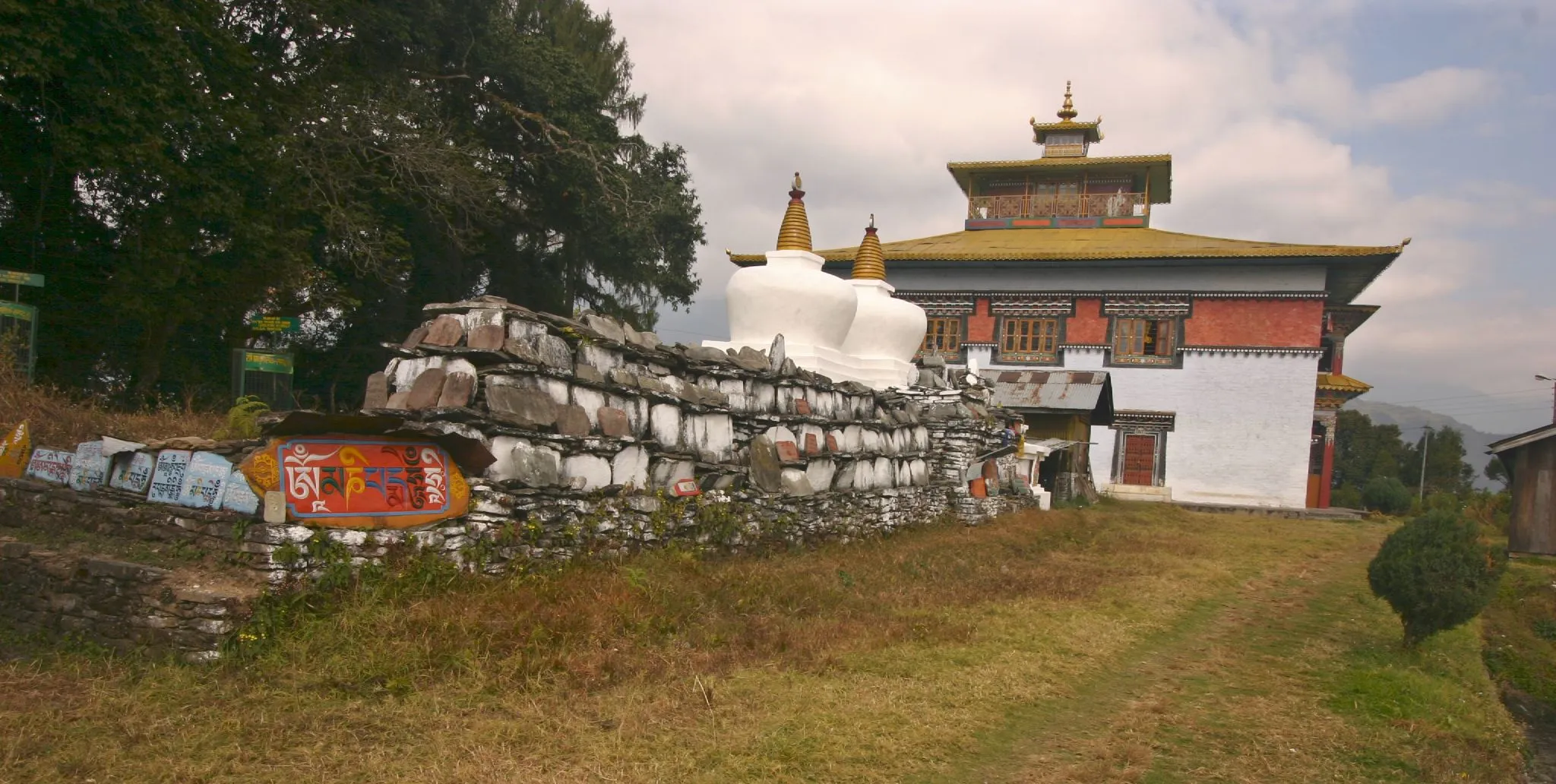
The most sacred monastery in Sikkim, home to the legendary Thongwa Rangdol chorten — a stupa so powerful that merely seeing it plants the seeds of liberation. Site of the prophetic Bumchu water festival.
The Heart of the Hidden Valley
Sikkim is no ordinary place. According to Tibetan tradition, it is Beyul Demojong (སྦས་ཡུལ་འདེ་མོ་ཇོང) — one of the hidden valleys prophesied by Padmasambhava as refuges during times of strife. When darkness covers the world, these hidden lands open to those with pure karma, offering sanctuary and the conditions for practice.
At the spiritual heart of this hidden valley sits Tashiding Monastery, perched on a heart-shaped hill at the sacred confluence of the Rathong and Rangit rivers. This geography is not accidental — in Tibetan sacred geography, river confluences are places of exceptional power, where different energies merge and purify each other.
The name Tashiding means “Devoted Central Glory” — and for Sikkimese Buddhists, no site in their homeland carries greater spiritual weight.
The Founding of Buddhism in Sikkim
The story of Tashiding is inseparable from the story of how Buddhism came to Sikkim. In 1641, three lamas converged on this land from three directions, fulfilling a prophecy of Padmasambhava:
Lhatsun Chenpo came from the north, crossing the high passes from Tibet. He was a renowned Nyingma master, a tertön (treasure revealer) who had discovered hidden teachings of Guru Rinpoche.
Ngadak Sempa Chenpo came from the west. He would become the founder of Tashiding.
Kathok Kuntu Zangpo came from the south, representing the great Kathok Monastery lineage.
These three masters met at Yuksom, where they enthroned the first Chogyal (Dharma King) of Sikkim, Phuntsok Namgyal, establishing the kingdom as a Buddhist realm. They then established monasteries throughout the land. Ngadak Sempa Chenpo chose the heart-shaped hill at the river confluence for his seat, founding Tashiding.
The Thongwa Rangdol: Liberation Through Seeing
Tashiding’s supreme treasure is the Thongwa Rangdol (མཐོང་བ་རང་གྲོལ) chorten — whose name means “Liberation Through Seeing.” This is an extraordinary claim: most Buddhist teachings emphasize that liberation requires practice, effort, and realization. Yet this stupa is said to be so powerful that merely gazing upon it with faith plants the seeds of liberation in one’s mindstream.
How is this possible? According to the teachings, certain objects become so saturated with blessing — through the relics they contain, the prayers invested in them, and the enlightened intention of their creators — that they function as direct transmitters of awakening. The Thongwa Rangdol is said to contain relics of immense power, consecrated by masters of the highest realization.
The stupa sits in the monastery courtyard, surrounded by smaller stupas and prayer wheels. Pilgrims circumambulate it continuously, but the essential practice is simply to look — to gaze upon it with faith, openness, and the aspiration for liberation. Each moment of such seeing plants karmic seeds that will eventually ripen as awakening.
For elderly Sikkimese who may not be able to undertake difficult pilgrimages, the Thongwa Rangdol offers a precious opportunity: liberation made accessible through the simple act of devoted seeing.
The Bumchu: Prophecy in Water
Once a year, Tashiding becomes the site of one of the most remarkable festivals in the Buddhist world: the Bumchu (བུམ་ཆུ), literally “Vase Water.”
At the heart of this festival is a sacred vase that has been sealed since the 18th century. According to tradition, the vase was consecrated by Lhatsun Chenpo and contains water blessed by the founding masters. Once a year, on the full moon of the first Tibetan month (usually February or March), the vase is opened by the monastery’s senior lamas.
The prophecy:
- If the vase is full, the coming year will bring abundant harvests and prosperity
- If the vase is nearly full, the year will be average
- If the vase is low, difficult times lie ahead
- If the water is clear, peace will prevail; if murky, conflict threatens
The water level and quality are observed and recorded, and the prophecy is announced to the assembled pilgrims. After the reading, the water is supplemented, the vase is resealed for another year, and the blessed water is distributed to the thousands of devotees who have gathered.
Receiving Bumchu water is considered extraordinarily auspicious. Pilgrims treasure it, using drops for blessing, healing, and protection throughout the year. Some families have maintained small bottles of Bumchu water for generations, adding fresh blessed water each year to maintain continuity.
The festival draws Buddhists from across Sikkim, neighboring Darjeeling, Nepal, and Bhutan. For two days, the normally quiet monastery transforms into a sea of devotees, with prayers, masked dances, and the unique energy of prophecy being revealed.
The Sacred Geography
Tashiding’s location embodies the principles of Tibetan sacred geography:
The Heart-Shaped Hill: The monastery sits on a hill whose shape, seen from above, resembles a heart. This is understood not as coincidence but as the landscape itself expressing the site’s nature as the spiritual heart of the region.
The River Confluence: The meeting of the Rathong and Rangit rivers at the hill’s base creates what Tibetans call a drutso (འབྲུ་མཚོ), a power point where energies converge. Such confluences are considered ideal for spiritual practice.
The Directions: The hill’s position allows views in all directions, symbolizing the all-pervading nature of enlightened awareness.
The Three Peaks: Tashiding is surrounded by three sacred peaks, forming a natural mandala that protects and empowers the site.
Circumambulating the monastery means walking around this entire sacred geography, not just a building. The kora path takes pilgrims through the landscape, past prayer flags, smaller shrines, and viewpoints that reveal the site’s natural mandala structure.
The Monastery Today
Tashiding remains an active Nyingma monastery, though like all Sikkimese monasteries it has been affected by the region’s integration into India (1975) and the changes of modern times. The monastery has been renovated several times, with the main temple containing:
- Images of Padmasambhava in various forms
- Statues of the founding lamas of Sikkim
- The Thongwa Rangdol chorten in the courtyard
- Ancient murals depicting the life of Guru Rinpoche
- The sealed Bumchu vase (visible only during the festival)
The monastic community maintains daily practices and annual ceremonies, preserving the traditions established by Ngadak Sempa Chenpo nearly four centuries ago.
Pilgrimage to Tashiding
Getting there: Tashiding is accessible by road from Pelling or Yuksom in West Sikkim. The final approach requires climbing approximately 150 stone steps from the road.
What to do:
- Circumambulate the monastery complex clockwise
- Spend time gazing at the Thongwa Rangdol with devotion
- Visit the main temple and receive blessings
- Walk to the viewpoint overlooking the river confluence
- If visiting during Bumchu, arrive early and prepare for crowds
Timing: The Bumchu festival (February/March) is the most auspicious time but also the most crowded. For quieter pilgrimage, visit during the dry season (October-May) when the weather is pleasant.
Permits: Foreign visitors to Sikkim require a Restricted Area Permit (RAP), easily obtainable at various entry points. Additional permits may be required for certain areas.
The Hidden Valley Opens
Padmasambhava prophesied that Beyul Demojong would open during times of darkness, offering refuge to practitioners. Some say the hidden valley opened in the 17th century when the three lamas arrived and established Buddhism. Others say it remains hidden in a deeper sense, revealing its full blessings only to those who approach with pure motivation.
What is certain is that Tashiding, sitting at the heart of this hidden valley, continues to offer something remarkable: a stupa that liberates through seeing, water that prophesies the future, and a direct connection to the masters who opened this land to the dharma.
For pilgrims who make their way to this heart-shaped hill at the confluence of rivers, who gaze upon the Thongwa Rangdol with faith, who receive the blessed Bumchu water and circumambulate the sacred geography — something shifts. The seeds of liberation are planted. The hidden valley reveals a glimpse of its secret. And the blessing of Guru Rinpoche, channeled through his devoted followers across the centuries, flows into yet another fortunate being.
This is what pilgrimage means: to place oneself in the stream of blessing and to allow it to carry one toward awakening.
Associated Masters
Principal Deities
Sacred Festivals
Bumchu Festival
14th-15th day of 1st Tibetan month (February/March)The sacred vase is opened and water level read as prophecy; blessed water distributed to pilgrims
Guru Tsechu
10th day of various monthsSacred mask dances honoring Padmasambhava
Recommended Practices
- ༔ Circumambulation of the monastery and Thongwa Rangdol stupa
- ༔ Viewing the Thongwa Rangdol with devoted attention
- ༔ Prostrations at the main shrine
- ༔ Receiving blessed Bumchu water (during festival)
- ༔ Meditation on the hill overlooking the confluence