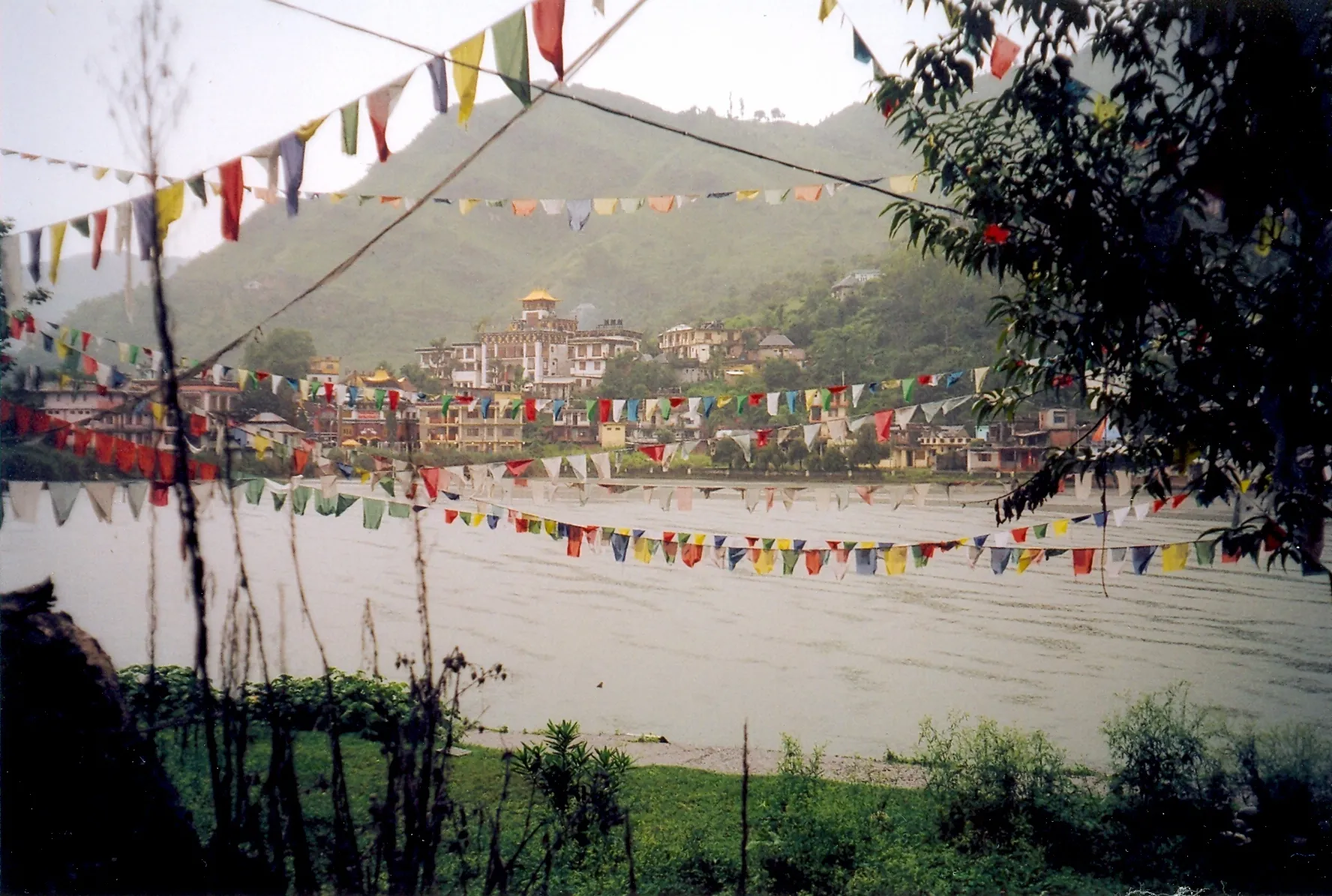
The Lotus Lake where Padmasambhava manifested his miraculous powers, transforming a burning pyre into a lake and converting a hostile king to Buddhism. The floating reed islands still drift across its waters, testimony to events over twelve centuries ago.
The Lake of the Lotus
High in the Himalayan foothills of India’s Himachal Pradesh, a small lake lies cupped in forested hills. Its waters are green with algae; floating islands of reeds drift slowly across its surface, pushed by wind or, the faithful say, by invisible forces. This is Tso Pema — the Lotus Lake — one of the most important pilgrimage sites associated with Padmasambhava, the master who brought Vajrayana Buddhism to Tibet.
The lake is called Rewalsar in Hindi, but Tibetan Buddhists know it by its sacred name: མཚོ་པདྨ — the Lake of the Lotus. The name commemorates the miracle that occurred here over 1,200 years ago, when the great tantric master proved his realization through an act that defied the laws of nature.
Today, the lake is surrounded by temples of three faiths — Buddhist, Hindu, and Sikh — who each claim connection to this power place. But for Tibetan Buddhists, Rewalsar is above all the site of Padmasambhava’s victory over ignorance, where he transformed persecution into liberation and converted a hostile king to the dharma.
The Story of Mandarava
The tale of Rewalsar begins with a princess. Mandarava was the daughter of King Arshadhara (also known as King Vihardhara) of Zahor, a kingdom in what is now Himachal Pradesh. She was renowned for her beauty, but she had no interest in worldly life. Instead, she practiced dharma in a convent with her attendants, seeking liberation rather than marriage.
When Padmasambhava came to Zahor, Mandarava recognized him as an enlightened master and became his student and spiritual consort. Their relationship was purely spiritual — the union of wisdom and skillful means that characterizes tantric practice — but the king and his ministers saw only scandal.
Enraged that a wandering yogi had “corrupted” his daughter, the king ordered Padmasambhava’s execution. The master was bound, wrapped in oil-soaked cloth, and set afire on a great pyre. Mandarava was thrown into a pit of thorns.
For seven days, the pyre burned. Smoke rose into the sky; the people of Zahor believed the foreign yogi was being consumed. But Padmasambhava had transformed the fire into water, the smoke into clouds. When the flames finally subsided, onlookers found not ashes but a lake — and in the center of the lake, seated on an open lotus flower, perfectly serene: Padmasambhava.
The Conversion of the King
King Arshadhara, witnessing this miracle, experienced a complete reversal. The man he had condemned as a charlatan was clearly a being of extraordinary power. But more than the display of power, it was Padmasambhava’s response that transformed the king: the master showed no anger, no resentment, no desire for revenge. He simply sat, radiant with compassion, ready to teach.
The king prostrated before Padmasambhava, confessed his error, and begged for teaching. His daughter Mandarava was released from the pit, unharmed. The entire court converted to Buddhism. King Arshadhara became one of Padmasambhava’s devoted followers.
This transformation — from persecution to devotion — lies at the heart of Rewalsar’s significance. The lake is not merely a memorial to miraculous powers. It is testimony to the triumph of compassion over aggression, of wisdom over ignorance. The same fire that was meant to destroy became the means of liberation.
The Lake Today
Rewalsar remains a small lake, perhaps 500 meters across. Its most remarkable feature is the floating islands — masses of reeds and vegetation that drift across the surface. Some are large enough to support small shrines; all are considered sacred.
Tibetan Buddhists believe these islands move according to the prayers of practitioners and the blessing of Padmasambhava. Pilgrims watch them closely, taking their movements as signs. When the islands drift toward a particular temple or location, it is read as auspicious.
The lake is fed by springs and has no visible outlet, yet its level remains relatively constant — another minor miracle, some say.
The Sacred Sites
The Nyingma Monastery — Perched on the hillside above the lake, this monastery is the main center for Tibetan Buddhist practice at Rewalsar. It houses a large statue of Padmasambhava and serves as a base for the many monks and lay practitioners who come on pilgrimage.
The Guru Rinpoche Cave — Above the monastery, a cave marks the spot where Padmasambhava is believed to have meditated. The cave contains sacred impressions and is a powerful site for practice.
The Giant Statue — A 37.5-meter (123-foot) statue of Padmasambhava dominates the hillside above the lake. Completed in 2012, it represents the master in his peaceful form and is visible from throughout the valley.
The Kora Path — A circumambulation path circles the lake, passing Buddhist, Hindu, and Sikh temples. The full circuit takes about an hour and is lined with prayer wheels.
The Three Faiths
Rewalsar is unusual in hosting important sites for three major religions:
Buddhism — The Tibetan Buddhist temples and the legend of Padmasambhava draw practitioners from across the Himalayan world.
Hinduism — A floating temple on the lake is dedicated to the sage Lomas, said to have meditated here. Several Hindu shrines dot the area.
Sikhism — Guru Gobind Singh, the tenth Sikh Guru, visited Rewalsar in 1701, and a gurdwara (Sikh temple) commemorates his stay.
This interfaith nature creates a unique atmosphere. Pilgrims of different faiths share the circumambulation path, each seeing the lake through their own tradition but sharing the physical practice of walking, praying, and offering.
Practice at Rewalsar
For Tibetan Buddhist practitioners, pilgrimage to Rewalsar typically includes:
Lake Kora — Circumambulation of the lake while reciting mantras, especially the Vajra Guru mantra (Om Ah Hum Vajra Guru Padma Siddhi Hum). Many practitioners complete 3, 7, or 21 circuits.
Cave Meditation — Sitting in or near Padmasambhava’s meditation cave, practicing guru yoga or simply resting in awareness.
Butter Lamp Offerings — Lighting lamps at the monastery and other shrines, each flame a prayer for all beings.
Feeding the Fish — The lake is full of fish, and feeding them is considered meritorious. Vendors sell appropriate food; pilgrims toss it into the water while making prayers.
Tsechu Celebrations — The 10th day of each Tibetan month is sacred to Padmasambhava, and the celebrations at Rewalsar on these days are particularly vibrant. The festival of his birthday (10th day of the 5th month) draws especially large crowds.
The Teaching of Tso Pema
What does Rewalsar teach? The outer lesson is about miraculous power — the ability of a realized master to transform fire into water, death into life, persecution into conversion.
But the inner lesson goes deeper. Padmasambhava did not fight fire with fire. He did not curse his persecutors or call down divine wrath. Instead, he transformed the situation through the power of realization itself. The fire became a lake. The hostile king became a devoted student. The site of attempted execution became a place of liberation.
This is the essence of tantric transformation: not rejecting negative circumstances but using them as the fuel for awakening. The same energy that drives anger can become the energy of wisdom. The same fire that destroys can become the water that purifies.
Rewalsar embodies this teaching. The lake exists because of the king’s aggression. The lotus grew from the fire. The floating islands drift on waters born from flames.
For pilgrims who walk the kora, reciting mantras as the islands drift by, this teaching becomes embodied. Whatever circumstances they face in their own lives — whatever fires burn — the example of Padmasambhava at Tso Pema offers a possibility: transformation, liberation, the lotus born from mud.
Associated Masters
Principal Deities
Sacred Festivals
Tsechu (10th Day Festival)
10th day of Tibetan months, especially 5th monthCelebrations honoring Padmasambhava, particularly elaborate on his birthday
Recommended Practices
- ༔ Circumambulation of the lake
- ༔ Meditation in the Guru Rinpoche cave
- ༔ Offering of butter lamps
- ༔ Recitation of the Seven Line Prayer