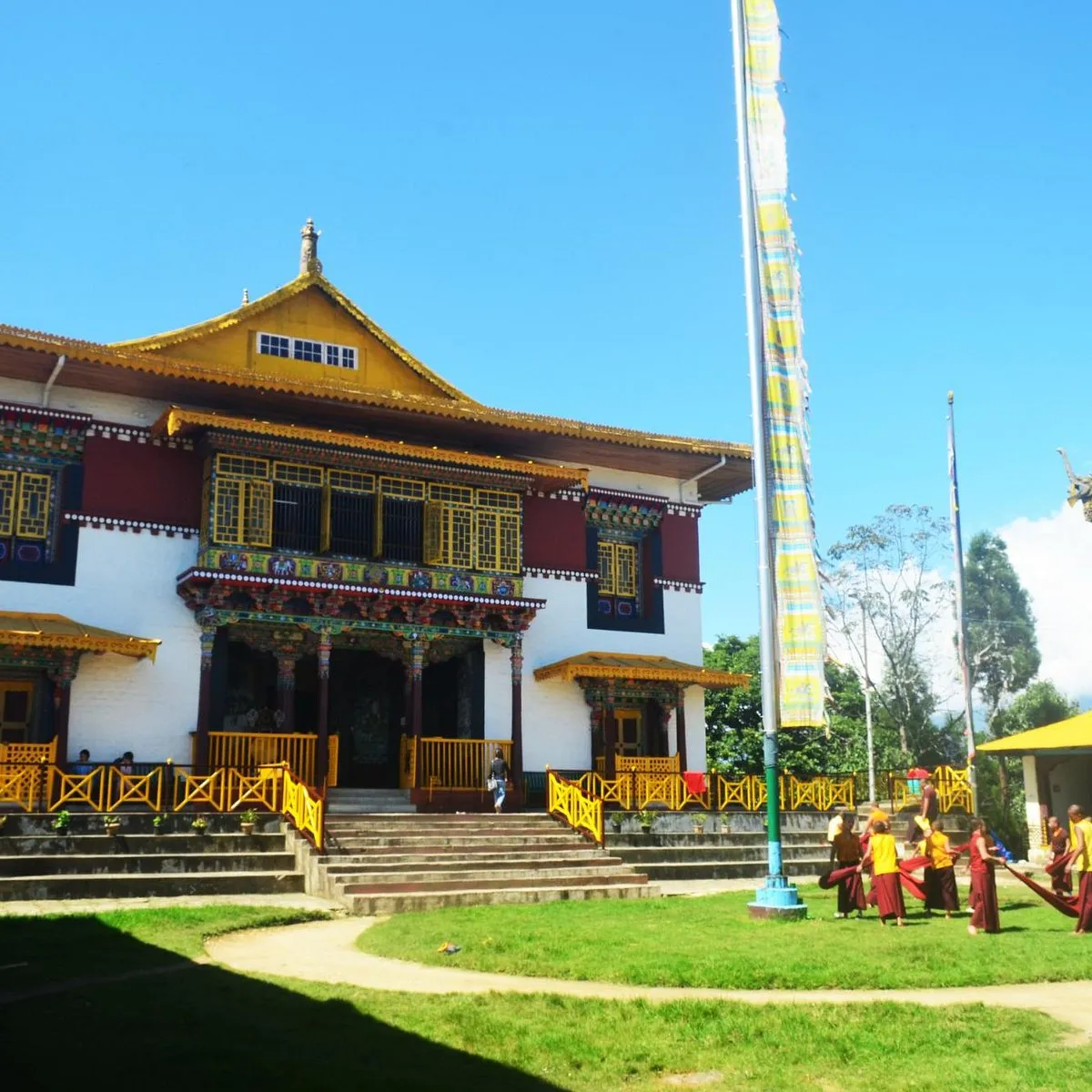
One of Sikkim's oldest and most important monasteries, founded for 'pure, celibate monks of pure Tibetan blood.' Houses an extraordinary seven-tiered wooden model of Padmasambhava's celestial palace.
The Perfect Sublime Lotus
Pemayangtse means “Perfect Sublime Lotus,” and this monastery was established with an unusual distinction: only monks of “pure Tibetan blood” who maintained celibacy could be ordained here. This rule, established by founder Lhatsun Chenpo, was intended to maintain the highest monastic standards.
The monastery sits on a ridge at 2,085 meters with commanding views of the Himalayan range, including Kanchenjunga. Its position and prestige made it the head monastery of the Nyingma tradition in Sikkim, with its head lama traditionally holding significant authority in religious matters.
The Sangthokpalri
Pemayangtse’s greatest treasure is the Sangthokpalri — a seven-tiered wooden model of Zangdok Palri, Padmasambhava’s celestial palace on the Copper-Colored Mountain.
This extraordinary sculpture fills an entire room on the monastery’s top floor. Created by the late Dungzin Rinpoche over five years, it depicts in intricate wooden detail:
- The Copper-Colored Mountain where Guru Rinpoche is said to reside
- Celestial beings, dakinis, and protectors in countless forms
- The various realms of existence surrounding the central palace
- Rainbow light and offering clouds rendered in painted wood
The level of detail is extraordinary — tiny figures, miniature temples, delicate clouds, all carved from wood and painted in vibrant colors. For devotees, viewing the Sangthokpalri is more than seeing art; it is glimpsing the realm where Padmasambhava continues to teach those who have the karma to reach him.
History and Significance
Pemayangtse traces its founding to Lhatsun Chenpo, one of the three lamas who established Buddhism in Sikkim. He built a small temple here in the late 17th century; the current structure dates from 1705.
The monastery was the highest ecclesiastical authority in Sikkim, second only to the Chogyal (king). Its monks performed important state rituals, and its approval was required for succession and coronation.
After Sikkim’s merger with India in 1975, this political role ended, but Pemayangtse remains the most important Nyingma monastery in the state. About 100 monks are in residence, maintaining daily practices and annual rituals.
The Annual Cham
Each February, Pemayangtse hosts Cham — sacred mask dances performed by monks in elaborate costumes and masks representing deities, protectors, and demons.
These are not performances but religious practices, transmitting blessing to those who witness them. The dances depict:
- The subjugation of negative forces by wisdom deities
- Stories from the life of Padmasambhava
- The victory of dharma over obstacles
During Cham, the monastery’s ancient thangkas are displayed, and the surrounding area fills with Sikkimese families who come for blessing and celebration.
Associated Masters
Sacred Festivals
Cham (Mask Dance Festival)
28th-29th day of 12th Tibetan month (February)Sacred warrior dances performed by monks
Recommended Practices
- ༔ Viewing the Sangthokpalri with devotion
- ༔ Prostrations at the main shrine
- ༔ Circumambulation
- ༔ Attending the annual cham dances