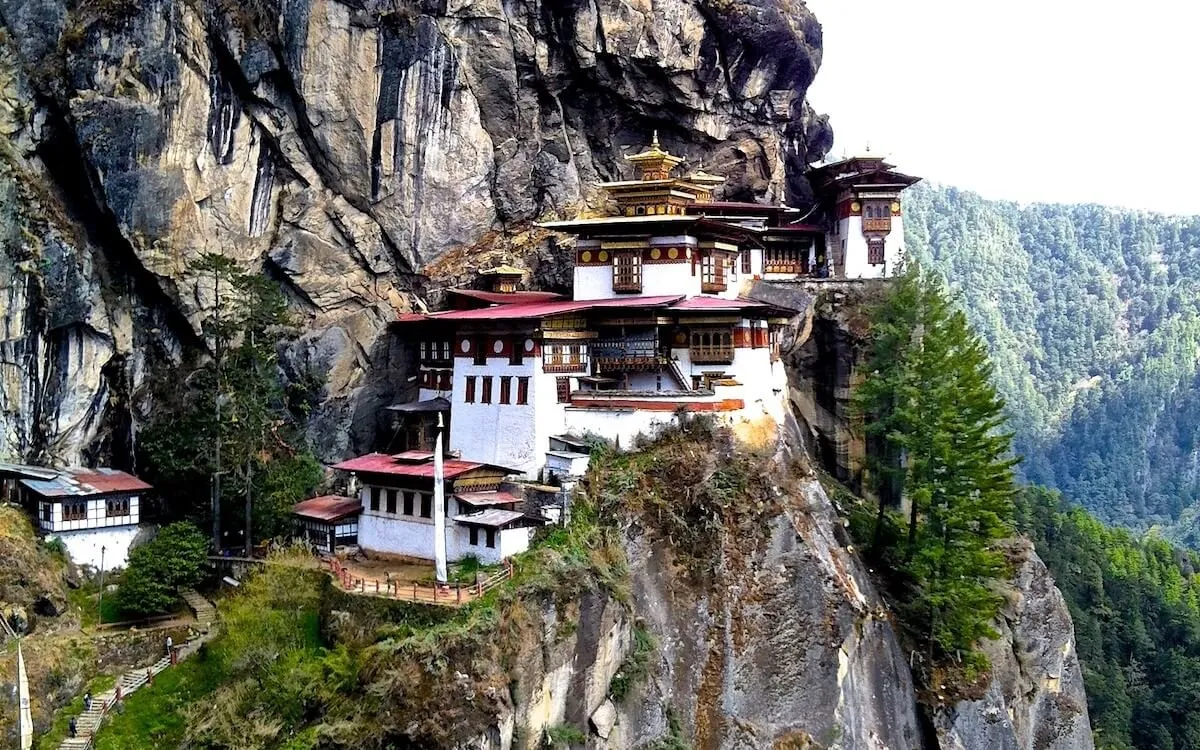
Bhutan's most iconic sacred site, clinging impossibly to a sheer cliff face 900 meters above the valley floor. Here Padmasambhava arrived flying on the back of a tigress to subdue local demons, establishing Buddhism in Bhutan.
The Impossible Temple
The first sight of Taktsang is always a shock. High on a sheer granite cliff, white buildings with golden roofs cling to the rock face at impossible angles. Below, a void of 900 meters drops to the valley floor. Above, the cliff continues to mountain peaks. In between, seemingly suspended in air, sits one of the most sacred sites in the Buddhist world.
Taktsang — the “Tiger’s Lair” — takes its name from the legend of how Padmasambhava arrived here in the 8th century. The great master flew from Tibet on the back of his consort Yeshe Tsogyal, who had transformed herself into a tigress. Landing on this cliff, he meditated in a cave for three months, subduing the local demons and binding them as protectors of the dharma.
For Bhutanese Buddhists, this is the site where their nation’s Buddhist identity was established. For pilgrims from across the Himalayan world, it is one of the most powerful né (power places) in existence — a location where the veil between ordinary reality and enlightened reality is extraordinarily thin.
The Eight Manifestations Cave
Taktsang is particularly associated with Dorje Drolo (རྡོ་རྗེ་གྲོ་ལོད), one of the eight manifestations of Padmasambhava. In this wrathful form, Guru Rinpoche appears as a wild figure, trampling on a pregnant tigress, with flames radiating from his body and a terrifying expression. This form represents the power to overcome the most stubborn obstacles and negative forces.
The original meditation cave where Padmasambhava practiced is still preserved within the monastery complex. Known as the Pelphug (“Sacred Cave”), it is the innermost shrine and the destination of every pilgrim’s journey. The cave is small and dark, lit only by butter lamps, and contains an image of Padmasambhava that is believed to radiate blessing.
Legend holds that other great masters also meditated in this cave system, including Milarepa in the 11th century and Shabdrung Ngawang Namgyal, who unified Bhutan in the 17th century. Each left their blessing, adding to the site’s spiritual power.
The Journey
No one drives to Taktsang. The pilgrimage requires a trek of roughly 2-3 hours up a steep mountain trail, gaining 900 meters in elevation. For many visitors, especially those coming from low altitudes, this is a challenging journey. But the difficulty is itself part of the pilgrimage — the physical effort mirrors the spiritual effort of the path.
The trail stages:
Base (2,300m) — The trek begins at a parking area where horses can be hired for the first section. Prayer flags mark the trailhead, and the trail immediately begins climbing through blue pine forest.
Halfway Point — Cafeteria (2,940m) — After 1-1.5 hours of climbing, a small cafeteria offers tea, snacks, and stunning views of Taktsang across the valley. Horses cannot proceed beyond this point. Many pilgrims pause here to absorb the first clear view of their destination, seemingly floating on the cliff face opposite.
The Upper Trail — The path becomes steeper and more challenging, switching back through forest until reaching the viewpoint directly across from the monastery.
The Descent and Crossing — Here the path drops 100 meters into a ravine, crossing a waterfall by bridge. This waterfall, Sheling Drup (“100,000 Lamps”), is considered sacred; pilgrims often pause here to make offerings.
The Final Climb — Stone steps carved into the cliff face lead up to the monastery entrance. Some sections are very steep, with chains provided for handholds. The final approach requires navigating several hundred stone steps.
The Monastery Complex
The monastery complex that now exists was largely built in 1692 by Gyalse Tenzin Rabgye, the secular leader of Bhutan at the time. It was constructed around the original caves where Padmasambhava meditated, incorporating them into a larger structure.
In 1998, a devastating fire destroyed much of the complex. Many priceless relics and ancient murals were lost. But in keeping with the Buddhist understanding of impermanence, the Bhutanese rebuilt. The restoration, completed in 2005, recreated the monastery in faithful detail, and new images were consecrated with traditional rituals.
The main buildings include:
Dubkhang — The main meditation hall, containing images of Padmasambhava’s various manifestations.
Pelphug — The original cave where Guru Rinpoche meditated for three months. This small space, dripping with butter lamp soot and ancient blessings, is the spiritual heart of Taktsang.
Zangto Pelri — A chapel representing Padmasambhava’s pure land, the “Copper-Colored Mountain” where he is said to currently reside.
Drolma Lhakhang — A temple dedicated to Tara, the female bodhisattva of compassion.
Eight Caves — Beyond the main structures, additional meditation caves are scattered across the cliff face, each associated with different aspects of Padmasambhava’s practice.
The Blessing of Guru Rinpoche
For Bhutanese Buddhists, visiting Taktsang is not simply seeing an impressive temple — it is receiving the blessing of Padmasambhava himself. The power that Guru Rinpoche generated here through his practice is believed to remain, accessible to those who come with faith and devotion.
Traditional practices at Taktsang:
Prostrations — Many pilgrims perform prostrations throughout their climb, measuring the path with their bodies.
Mantra recitation — The Vajra Guru mantra (OM AH HUM VAJRA GURU PADMA SIDDHI HUM) is recited continuously throughout the journey.
Butter lamp offerings — Lighting butter lamps in the main shrines, each flame representing a prayer for all beings.
Circumambulation — Walking clockwise around the monastery complex and individual shrines.
Prayer flags — Hanging prayer flags at designated spots, where the wind will carry their mantras across the land.
The Tigers of Taktsang
The tigress of Taktsang is everywhere. Stone tigers guard the entrance. Tiger images decorate the temples. The name itself evokes the wild, untameable nature of enlightened energy.
In Buddhist iconography, the tiger represents the power of transformation. Just as a tiger has the strength to kill, enlightened awareness has the power to destroy ignorance. The tigress that carried Padmasambhava represents Yeshe Tsogyal, his primary consort and the first Tibetan woman to achieve enlightenment. Her transformation into a tigress symbolizes the fierce feminine wisdom that helps overcome obstacles.
There’s another layer to the tiger symbolism. In the tantric path, practitioners work with powerful emotions and energies that could be destructive if mishandled — like riding a tiger. The accomplished master doesn’t suppress these energies but rides them to enlightenment. Taktsang, where Guru Rinpoche arrived on a tigress, is thus a perfect symbol for the tantric path itself.
Practical Pilgrimage
Entry requirements: All visitors to Bhutan require a visa, and until recently, were required to pay a substantial daily fee. Regulations have changed, but Taktsang itself requires an entrance fee.
What to bring:
- Sturdy walking shoes
- Water
- Layers (weather can change quickly)
- Camera (photos inside temples are not permitted)
- Small offerings (money or khata scarves)
What to know:
- The monastery is closed to visitors on certain sacred days
- Modest dress is required (no shorts or sleeveless shirts)
- Photography inside the temples is forbidden
- Silence or quiet speech is expected within the complex
- Shoes must be removed before entering shrines
Physical requirements:
- The trek is 4-6 hours round trip
- Altitude gain is significant (900m)
- Walking sticks and horses (for the first half) are available
- Those with health concerns should consult a doctor
The Return Journey
There’s a saying among Bhutanese pilgrims: “The way up is the pilgrimage; the way down is the blessing.” Having received the blessing of Guru Rinpoche’s power place, pilgrims descend through the forest with a different energy than they climbed.
As the monastery recedes above, visible through breaks in the trees, pilgrims often pause to look back. The white buildings seem even more impossible from below — how could anyone have built there? How can they remain?
Perhaps that’s the teaching of Taktsang itself. What seems impossible is possible. What clings to the cliff does not fall. What appears to have no foundation is supported by something invisible but unshakeable. Like the dharma. Like devotion. Like the blessings of the masters that flow continuously through time and space to reach anyone who opens to receive them.
The tigress brought Guru Rinpoche to this cliff 1,200 years ago. The power he generated here has never diminished. Every pilgrim who makes the journey becomes part of an unbroken stream of devotion stretching from the 8th century to the present moment — and on into the future, as long as there are beings who seek the tiger’s lair.
Associated Masters
Principal Deities
Sacred Festivals
Tsechu
10th day of various Bhutanese monthsSacred mask dances honoring Padmasambhava
Recommended Practices
- ༔ Pilgrimage trek to the monastery (2-3 hour climb)
- ༔ Prostrations at the main shrine
- ༔ Circumambulation of the monastery complex
- ༔ Meditation in the outer caves
- ༔ Mantra recitation of Guru Rinpoche's mantra