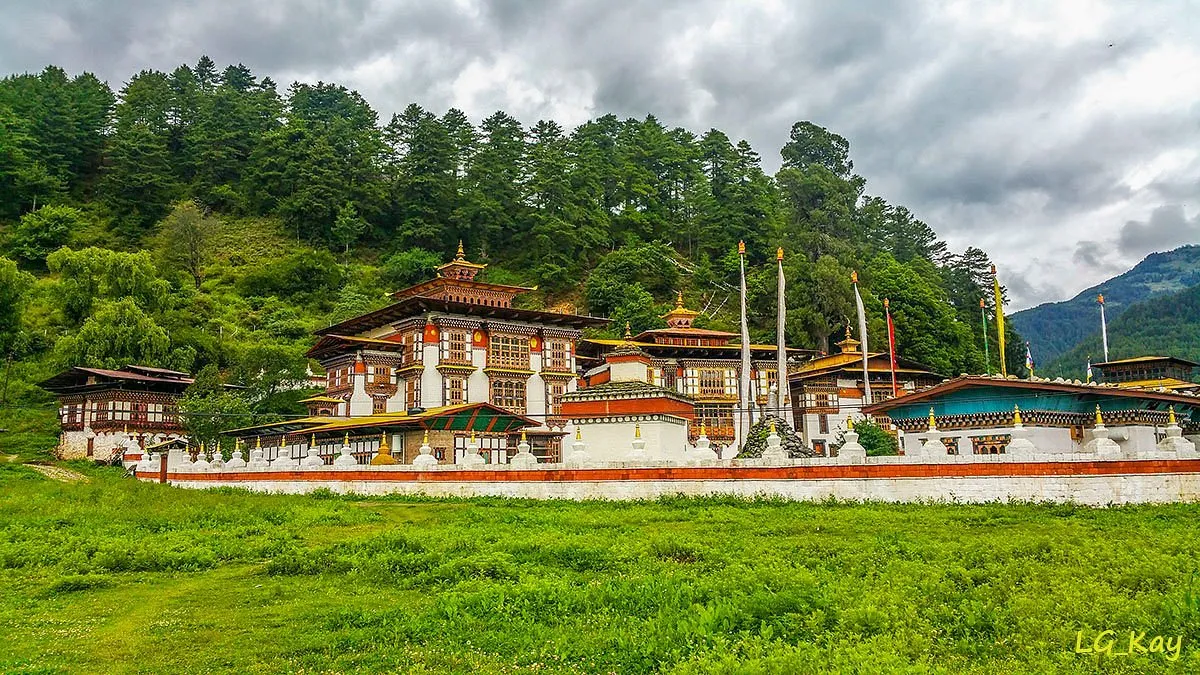
One of Bhutan's most sacred sites, where Padmasambhava left his body imprint in solid rock. The name 'Kurje' means 'body imprint' — physical evidence of the master's presence that pilgrims can still see today.
The Body Imprint
In the sacred Bumthang Valley — Bhutan’s spiritual heartland — stands a temple complex built around one of the most tangible relics of Padmasambhava’s presence: his body imprint pressed into solid rock.
The name Kurje means “body imprint” (ku = body, je = imprint). According to tradition, when Guru Rinpoche meditated in a cave here in the 8th century, the power of his realization was so great that his body left a permanent impression in the rock. This imprint can still be seen today, drawing pilgrims who touch the rock and receive blessing from direct contact with the master’s presence.
Padmasambhava in Bumthang
The story of Kurje begins with King Sindhu Raja, the local ruler who was gravely ill. His son invited Padmasambhava to heal the king, and Guru Rinpoche came to Bumthang.
The illness was caused by a powerful local deity who had been offended. Rather than simply defeat this being, Padmasambhava transformed into his wrathful form, Dorje Drolo, and subdued the deity, binding it as a protector of dharma. He then meditated in the cave, leaving his body imprint, and healed the king.
This pattern — subduing local spirits and transforming them into protectors — repeated throughout Padmasambhava’s travels. At Kurje, the evidence of his power remains visible in the rock itself.
The Three Temples
The complex contains three main temples:
The First Temple: Built in 1652 around the sacred cave containing Guru Rinpoche’s body imprint. This is the innermost sanctum, where pilgrims come to touch the imprint and receive blessing.
The Second Temple: Built in 1900, containing a large statue of Padmasambhava and images of the thousand Buddhas.
The Third Temple: The largest, built in the 1990s under the direction of the Queen Mother. Contains massive statues of Padmasambhava and his two consorts.
The complex also includes a row of 108 stupas and a large juniper tree said to have grown from Guru Rinpoche’s walking stick.
Pilgrimage Practice
Pilgrims to Kurje typically:
- Enter the first temple and view the body imprint in the rock, touching it with devotion
- Circumambulate the complex, passing the 108 stupas
- Prostrate at various points within the temples
- Offer butter lamps at the shrines
- Meditate in the peaceful grounds with views of the Bumthang Valley
The site is especially powerful during the Kurje Tsechu, when sacred mask dances bring the stories of Padmasambhava to life and thousands of Bhutanese gather for blessing.
Associated Masters
Principal Deities
Sacred Festivals
Kurje Tsechu
10th day of 6th Bhutanese month (June)Sacred mask dances honoring Padmasambhava
Recommended Practices
- ༔ Viewing the body imprint with devotion
- ༔ Circumambulation of the temple complex
- ༔ Prostrations at the sacred cave
- ༔ Meditation at the site