Knowledge base
The instrument
The dranyen is a long-necked, fretless plucked lute — warm, resonant, and unmistakably Tibetan in silhouette, from its waisted body to the carved head crowning its neck.
Body & construction
The dranyen is a long-necked, two-waisted, fretless lute, usually hollowed from a single piece of wood and ranging from roughly 60 to 120 cm in length. Rather than a single round sound-hole, the soundboard carries rosette-shaped openings in the manner of old European lutes.2 On many Tibetan instruments the lower bout is closed not with wood but with a stretched skin (leather) membrane, giving the body its characteristic warm, slightly boxy voice.1
The head & pegs
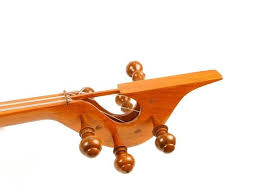
The neck is finished with a carved finial — most often a horse's head, echoing the horse cultures of Eurasia, and in Amdo a dragon's head (drug-go).1 The tuning pegs are traditionally said to take the shape of the phurba, the Tibetan ritual dagger — one of the small details the source literature names as part of the instrument's cultural signature.1
Strings & courses
The classic Tibetan dranyen carries six strings arranged in three double courses — three pairs, each pair tuned in unison.13 Strings were originally animal gut, today commonly nylon.2 (Some Himalayan variants, notably the Bhutanese dramyin, are described with seven strings, six of which run to the peg box.)2 It is played by strumming, finger-picking and plucking, with a distinctive strumming style noted as part of its identity.1
Tuning — the open courses
The instrument is tuned by its three open courses, not note by note. In the tuning documented for this archive — confirmed with a master player and verified against the recordings themselves — the courses are La · Re · So, and the instrument sits in D major (reference A = 440 Hz). Two of the seven scale degrees are re-entrant: So and La sound an octave below the rest, which is why they are written with a dot beneath the number.
| Course | Solfège | Pitch | Frequency |
|---|---|---|---|
| 1st (open) | La | B2 | 123.47 Hz |
| 2nd (open) | Re | E3 | 164.81 Hz |
| 3rd (open) | So | A2 | 110.00 Hz |
The full single-octave scale, low to high, runs So (A2) · La (B2) · Ti (C♯3) · Do (D3) · Re (E3) · Mi (F♯3) · Fa (G3). A subtle shimmer is natural to the instrument: the two strings of each course sit a few cents apart, so they gently beat against one another — measured at roughly 2–7 cents in our reference recordings.
You can hear and match these pitches with the built-in tuner, which guides you course by course (La → Re → So) and listens through your microphone.
A note on classification
Curiously, Tibetan tradition classifies the dranyen within the percussion family, whereas Western organology places it among chordophones (strings) — a small reminder that instruments carry the worldview of the culture that names them.1
Notes & sources
- Tashi Tenzin, Dranyen: A Study in Tibetan Identity, Tibet Policy Institute.
- “Dramyin,” Wikipedia (construction, dimensions, strings, materials).
- Organology & the “La-re-so” solfège study on three double-course tuning. See References.