Knowledge base
History & origins of the dranyen
For roughly a thousand years the dranyen has been the foundation of Tibetan traditional music — an instrument believed to have been created on the plateau itself, yet woven from threads that reach across Central Asia.1
The name
The word dranyen (Tibetan སྒྲ་སྙན་, Wylie sgra-snyan) joins two syllables — dra (tune) and nyen (melody) — and is best rendered as “the instrument of melodious sound.” In Sanskrit sources it is linked to the tambura; in western Tibet it was once called goepo, and by the 17th century it was widely known as the Ngari dranyen after the Ngari region of its prominence.1 In the Tibetan system of classification it is grouped, unexpectedly, among the percussion family, while Western organology files it under strings.1
Origins in the 7th century
Most accounts place the instrument's emergence around the 7th century, during the reign of King Songtsen Gampo (c. 617–649 CE). Evidence is read from murals on the walls of the 8th-century Samye Monastery, the Rasa Trulnang temple (today's Jokhang), and the Potala Palace, which depict the king entertained by court minstrels playing dranyen.1 Chronicles record that when Songtsen Gampo's queens arrived from Nepal (634 CE) and China (641 CE), the royal receptions featured the dranyen among their instruments.1
Where did it come from?
Because the earliest history survives mostly through oral tradition, several theories coexist:
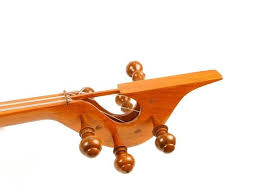
- Central Asian lutes. The ethnomusicologist Ian Collinge traces possible roots to short-necked lutes of Central Asia — the Tajik Kashgar rubab and the Uyghur Pamir robab — noting that the horse-head finial echoes the horse cultures spanning Eurasia from the Balkans to Mongolia.2
- The sarod / rubab line. Some hold it was adapted from the Indian sarod — itself a descendant of the Afghan rubab — carried by Kashmiri Muslim (Khache) communities.1
- The Saraswati legend. Others tie it to the goddess Saraswati (Tibetan Lhamo Yangchenma), often depicted with a tambura on her lap, as patron of music and learning.1
- Kongpo's forests. A practical tradition holds the instrument was shaped in southern Tibet's forested Kongpo region, prized for its dense timber.1
The scholarly consensus in the source literature is that, whatever its inspirations, the instrument as it exists today was creatively developed within Tibet and resembles no other instrument now in use.1
Becoming the “dranyen”
The instrument carried many regional names before being formally called dranyen during the rule of Tsang Desi Zhingshak Tseten Dorjee and his sons in Central Tibet (1565–1640).1 As it spread from Ngari into Central Tibet, Amdo and Kham, its design varied region to region — the carved horse's head of the centre and west giving way, in Amdo, to a carved dragon's head (drug-go).1
The golden age: the Fifth Dalai Lama
A high point came when the Great Fifth Dalai Lama established the Ganden Phodrang government in 1642. Under his regent Desi Sangye Gyatso, the master musician Tashi (son of Master Guti) was invited to Lhasa to set down the instrument's root text, and the classical genre Nangma-Toeshey was composed for the first time.1 Lyrics from this courtly tradition still circulate today — including the famous quatrain attributed to the Sixth Dalai Lama foretelling his own rebirth:
White crane! Lend me your wings,
I will not fly far —
from Lithang, I shall return.
In the late 18th century the musician Doring Tenzin Paljor brought the hammered dulcimer and the erhu from China to accompany the dranyen, and introduced the Chinese phuzi notation — opening an era of ensemble music and new forms.1
Street songs & the 20th century
Alongside courtly and folk music, a tradition of Lhasa street songs — political satire sung by ordinary people — flourished in the early 20th century, documented by the Tibetologist Melvyn C. Goldstein.3 The era also produced beloved figures such as the blind master Acho Namgyal, who renewed Tibet's musical landscape and taught a generation of players.1
Rupture and survival after 1959
Following the occupation of Tibet, traditional genres were banned outright during the Cultural Revolution (1966–1976), and musicians faced imprisonment for performing songs of resistance.1 In exile, the Tibetan Institute of Performing Arts (TIPA) — founded on 11 August 1959 and based in Dharamsala from 1961, under the patronage of the 14th Dalai Lama — became the heart of preservation, training more than 360 artists and 150 music teachers and, in 1993, publishing the first songbook of Nangma-Toeshey and Gharlu with lyrics and notation.14
That lineage runs directly into this project: among TIPA's leading 21st-century dranyen performers named in the source literature is Tenzin Norbu (“Tenor”), who trained under master Gonpo Dorjee — the same musician whose recordings power this site's instrument.1
The dranyen today
The dranyen lives on across the Tibetan world and the wider Himalaya — Ladakh, Sikkim, Himalayan West Bengal, and especially Bhutan, where the related dramyin accompanies Drukpa Buddhist song and dance.5 Teachers now reach students through websites and YouTube, and a growing body of scholarship — including work on teaching the instrument through solfège — is helping a new generation learn it.6 Preserving that living knowledge, intact and freely accessible, is the purpose of this archive.
Notes & sources
- Tashi Tenzin, Dranyen: A Study in Tibetan Identity, Tibet Policy Institute, Central Tibetan Administration.
- Ian Collinge, “Developments in Musicology in Tibet,” Asian Music XXVIII/1 (1996/97); and “The Dra-nyen (The Himalayan Lute): An emblem of Tibetan Culture,” Chime Journal 6 (1993). See References.
- Melvyn C. Goldstein, “Lhasa Street Songs: Political and Social Satire in Traditional Tibet.” See References.
- Tibetan Institute of Performing Arts (TIPA). See References.
- “Dramyin,” Wikipedia / Himalayan organology. See References.
- “La-re-so: Teaching the Tibetan Dranyen through Solfège.” See References.
This article summarises and cites published scholarship; quotations and dates follow the sources above. Corrections from scholars and tradition-holders are warmly welcomed.